From coding agents to agentic delivery: our view from GitHub Universe on the Road in Toronto
By Nick Van Exan ·
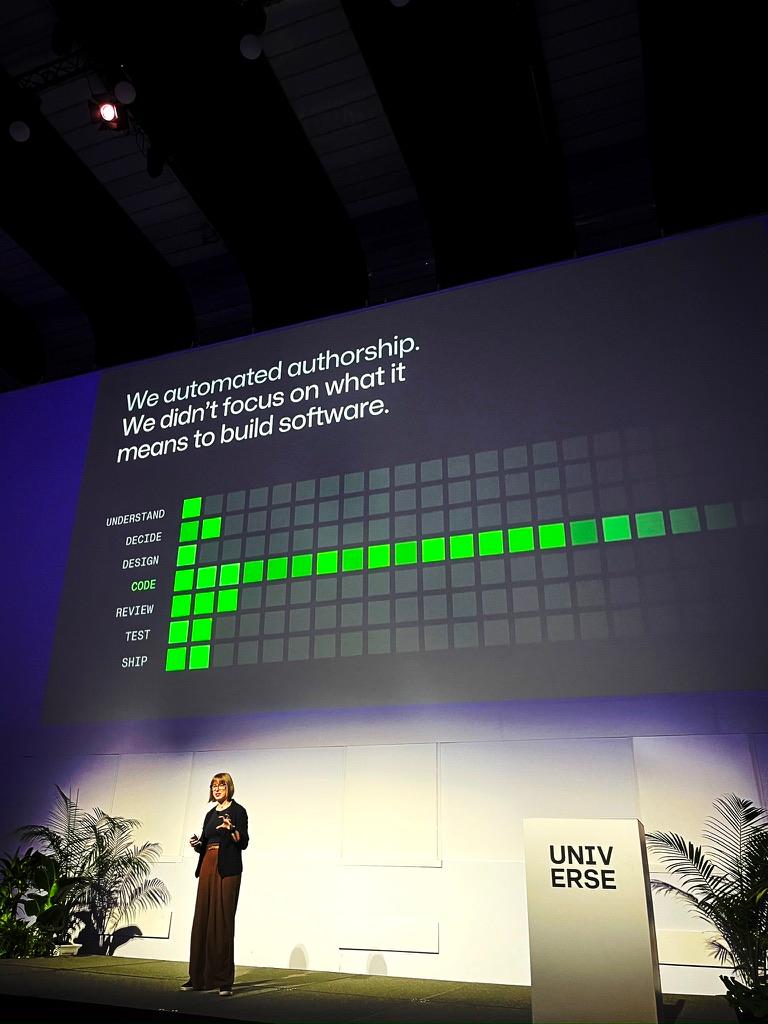
At GitHub Universe on the Road in Toronto last week, one keynote slide captured a question we’ve been working through at CodeLantern.
“We automated authorship. We didn’t focus on what it means to build software.”
Below it were seven rows. Understand. Decide. Design. Code. Review. Test. Ship. The green squares beside Code stretched almost across the screen.
As agents take on more implementation work, how do we help teams become better at everything involved in delivering a useful product?
Automating more of the work between decisions can give engineers more time to understand what customers need and greater responsibility for the product. Teams need support to change how they work as they adopt the technology.
From working with an agent to building a workflow
For many teams, AI adoption begins with a developer working alongside a coding agent. The developer supplies context, directs the work, checks the result, and decides what happens next. That experience helps people learn what agents can do and where they need guidance.
The next step is to make more of that process repeatable and shared.
An agentic workflow can take a request, gather relevant project context, help shape a specification, prepare an implementation, run checks, and bring the result back for review. Engineers design how that work proceeds, what information it needs, and where a person should become involved. A workflow might pause over an unresolved product question, seek agreement on a design, or flag a result that needs closer inspection.
The team can operate and improve the workflow together, sharing useful practices and carrying what they learn into the next task.
Organizations are at different points in this transition. Some are establishing their first shared practices around Copilot. Others are ready to delegate recurring work to agents. In both cases, agents need access to the project’s conventions, architectural decisions, tools, and expectations for quality.
Thoughtworks uses the term enterprise harness for this broader capability and argues that it deserves ongoing ownership and care. For an engineering leader, that means treating the instructions, context, integrations, and controls around agents as part of the organization’s engineering capability. Someone needs to maintain them and assess whether changes improve the work.
This is where CodeLantern can help. Our engineers specialize in designing and building agentic workflows on GitHub. We bring an established methodology and a working development harness to accelerate adoption, then work alongside your team to validate results, refine the system, and help your people take ownership of its ongoing operation and improvement.
Broader responsibility needs skilled people
As more implementation becomes automated, engineers have an opportunity to spend more time understanding a problem, exploring possible solutions, and working with customers and product owners to make decisions.
That takes technical depth. Someone still needs to recognize an architectural weakness, question a proposed design, and judge whether the evidence supports shipping a change. It also takes the ability to ask useful questions, explain trade-offs, and connect technical choices to product goals.
This is where T-shaped engineers, like our consultants at CodeLantern, become especially valuable. They bring deep engineering expertise alongside broader product, consulting, and communication skills. They can carry a conversation from “What are we trying to accomplish?” through to “How will we know this works?”
People need opportunities to practise these broader responsibilities and clarity about which decisions they own. Supporting them through that change is part of AI enablement.
Pairing on real work helps people make that transition. An engineer can learn to direct an agentic workflow while working alongside someone who knows how to shape the task, examine the design, and respond when the workflow needs help. Product owners participate in the same process, learning where their input has the greatest effect.
This also opens up different ways to organize a product team. One model we’re exploring brings a product manager and a senior product engineer together, with UX and QA support as the work requires. Agentic workflows handle more of the implementation, review, and testing, while the team stays close to the problem and accountable for what ships.
One product team · fractional UX and QA
The right balance depends on the product and its risks. For engineering leaders, this creates an opportunity to give a small team broader ownership of an outcome, supported by automation and access to specialist expertise.
A working foundation within GitHub
At CodeLantern, we’ve developed our methodology and technology by using them in our own engineering work.
We bring a development workflow tailored to GitHub that takes work from specification through implementation and review to a pull request. It combines reusable instructions and skills with project knowledge, tool integrations, and explicit points for human involvement.
The customer brings a problem or desired outcome, access to relevant context, and people who can answer questions and make decisions. We help turn that into a working delivery process within their GitHub environment.
As work progresses, the team can record decisions, clarify conventions, and retain lessons that would otherwise disappear into an individual agent session. These updates are reviewed and added to the project knowledge available for future work.
Bringing an existing workflow helps us get customers running quickly. Our engineers adapt it to the project and work alongside the team until they can operate and improve it themselves.
The workflow lives in GitHub, in the repository, issues, and pull requests the team uses every day.
What the transition looks like in practice
We’re currently working with a global engineering firm that is moving from an AI-built proof of concept toward a team shipping agentically.
One of our engineers is working alongside their team. In the first week, they worked through the project goals together. By week two, they had a scaffolded repository, and their senior engineer was shipping through the agentic workflow while pairing with ours.
That pairing is helping the engineer take on broader product responsibilities. With more of the building automated, the product owner, customer engineer, and our consultant have more time to work through intent and product questions while staying involved in design.
We’re also establishing the project knowledge base and value telemetry so the team can retain what they learn and examine how their delivery is changing.
Building the capability with your team
Start with a real piece of work and build the workflow around delivering it. That gives your team a chance to learn how to direct agents, make design decisions, and evaluate the results together.
That is the approach behind CodeLantern Spark. Over four weeks, our engineers work alongside yours on production work in your repository, using GitHub Copilot. We establish the workflow together and progressively move responsibility to your team.
For organizations ready to delegate specific recurring work, our Agentic Workflows engagement helps design and implement workflows with the project context, integrations, and human involvement they need.
We help your team get running in GitHub and learn to own and improve the workflow through real delivery.